

Introduction
If you have spent any time in the semiconductor industry, the problem of microchip obsolescence is hardly new. Part obsolescence has become one of the most persistent and costly challenges facing manufacturers of long-lifecycle systems, particularly in aerospace, defense, industrial automation, and medical equipment. These products can be in production for decades, whereas the lifecycle of an integrated circuit (IC) might only be a few years.
More than likely, part obsolescence has already caused you a headache or two. Why does this happen? Despite our best efforts to plan continuity of product supply, manufacturers still throw buyers curve balls. Older fabs or parts run their course and eventually reach their end-of-life (EOL). In other cases, mergers or strategic shifts lead to reducing product portfolios. EOL notices are sent, and buyers are (usually) afforded the chance at a “last-time buy” to build bridge inventory until another solution is designed and qualified for production. Ultimately, to continue production on a long-lifecycle system, a legacy part replacement strategy is needed.
The short-term solutions are not ideal. When a critical ASIC or mixed-signal IC reaches end-of-life status, OEMs are often forced to choose between time-consuming board redesigns, high-risk secondary market sourcing, or inventory stockpiling strategies that tie up cash without guaranteeing long-term continuity of supply.
In most cases, the best long-term solution for an obsolete ASIC or mixed-signal system-on-chip (SoC) device is to develop a drop-in replacement. A new ASIC can be custom designed to create a form-fit-function (FFF) compatible device.

Why Are So Many Parts Becoming Obsolete?
Today’s semiconductor market is downright giddy for artificial intelligence (AI) and high-performance computing (HPC). But as foundries prioritize capacity for the advanced nodes serving AI and HPC, mature processes and legacy devices have become increasingly vulnerable to discontinuation. Recent mergers and fab divestitures have also led to older technology and parts being discontinued.
For system manufacturers with platforms relying on outdated integrated circuit technologies, this creates an ongoing sustainment problem that can directly threaten continuity of supply, delivery commitments, and customer trust.
Legacy ASICs and mixed-signal ICs that have been built in older technologies can be among the hardest circuits to replace when discontinued. While some organizations attempt to source remaining stock from brokers to replace obsolete parts, this route often introduces counterfeit risk, inconsistent electrical performance, and questionable storage histories that complicate quality assurance and regulatory compliance.
Designing a new, drop-in ASIC replacement through a custom IC design avoids these pitfalls by preserving functionality, performance, and mechanical footprints. Furthermore, replacing a legacy device allows the opportunity to transition to a newer wafer technology that will have a longer lifetime.

Quick-Turn Obsolete ASIC Replacement
JEDEC has established clear and useful standards for timely customer notification of product discontinuance (see J-STD-048). This standard states a minimum of 6 months’ notice for last orders and 12 months for final shipments. However, not all semiconductor companies follow the standard. For example, a major fab was divested a few years ago, and customers were later informed they had one month to enter last time buy orders—and yes, it was painful for everyone affected. When EOL notifications arrive with such short notice, the need for a quick-turn ASIC replacement is paramount.
Custom Silicon Solutions (CSS) supports these programs through a vertically managed workflow that begins with rapid requirement definition—from partial schematics, netlists, or bench characterization—and proceeds through design implementation, wafer probe, final test, and packaged device qualification under a single coordinated engineering team. CSS circuit design engineers routinely engage in obsolete ASIC redesign programs using a combination of reverse engineering, electrical characterization, and thorough simulations to replicate the original analog, digital, and high-voltage functions.
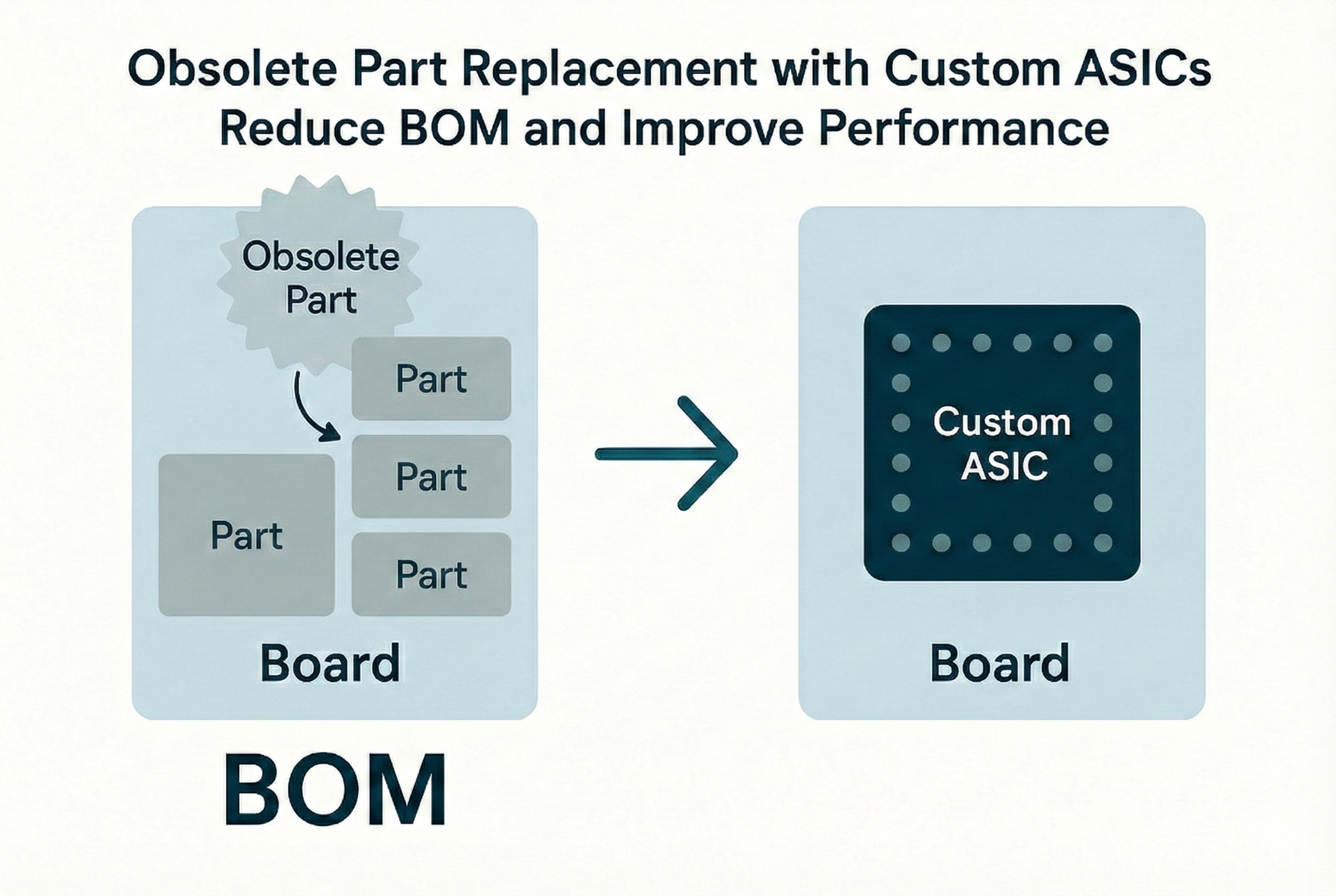
In some situations, customers may decide to improve performance or integrate additional content on chip. This approach allows multiple obsolete electronic components to be consolidated into a single ASIC—further reducing part count, printed circuit board complexity, and overall system cost.
At CSS, testing and validation are performed in-house within our Class 10,000 cleanroom facility in Irvine, California. With our test site and test engineers co-located with our design team, design iteration loops are shortened, enabling faster convergence on production-ready silicon. While all chips are different, at CSS it is not uncommon for a legacy ASIC replacement to be released for production in less than a year after starting the design.

Key Advantages of Custom ASICs
Replacing obsolete parts through custom ASICs provides value well beyond merely restoring availability:
- Supply Continuity
Direct manufacturing control removes reliance on unpredictable broker inventories and supports sustained production planning.
- Drop-In Compatibility
Form-fit-function ASIC replacements preserve pin-to-pin interfaces, electrical timing, and package dimensions.
- Design Consolidation
Multiple discrete parts can be integrated into a single chip, simplifying procurement and assembly.
- Higher Performance
Modern silicon supports improved signal integrity, precision analog functions, and thermal operation margins.
- Lower Power Consumption
Updated circuit architectures reduce both quiescent and dynamic power losses.
- IP Protection
Proprietary implementation within a custom integrated circuit makes functional replication by third parties significantly more difficult.
- Reliability Improvement
Fewer board components and interconnects reduce long-term failure rates.

Conclusion: Stabilize Legacy Platforms with Proven ASIC Expertise
As semiconductor obsolescence pressures accelerate across aging product portfolios, the value of a disciplined legacy part replacement strategy is both clear and compelling.
Rather than accepting supply risk, counterfeit exposure, or costly platform redesigns, OEMs can rely on a new custom ASIC that provides a drop-in replacement while unlocking opportunities for integration, performance upgrading, and lifecycle cost reduction.
With nearly three decades of success in legacy and mission-critical IC replacement, Custom Silicon Solutions delivers fast legacy ASIC redesign and long-term manufacturing that protect platform investments well into the future.

Your Path Forward
If your organization is facing an urgent replacement need for obsolete ICs or ASICs, contact CSS today to begin evaluating your drop-in replacement options. Our expert engineering team can provide a viable pathway to preserve production continuity while strengthening long-term system viability.